
Inventory Management
Amazon Inventory Management


The problem
A stockout can undo months of ad spend overnight
Stockouts cost you the rank
Stockouts kill your rank
A SKU that runs out loses the organic position and the sales momentum you spent months and a budget building. Getting it back is slower and more expensive than keeping it was.
Budget spent on stock you do not have
Campaigns keep bidding on a SKU with nine days of cover left. You pay for the clicks, the buyer finds it unavailable or back-ordered, and the conversion data gets worse at the same time.
Overstock and expiry eat the margin
Too much stock means aged inventory surcharges and capacity pressure, and in dated categories such as supplements, food and cosmetics it means write-offs on product that never sold.
The service
What is Amazon inventory management?
Amazon inventory management is forecasting demand, timing restocks around supplier and FBA lead times, and keeping advertising spend in step with stock position, so you avoid the stockouts that cost you rank, stop paying for clicks on SKUs you cannot fulfil, and keep storage, capacity and expiry costs under control.
We treat inventory as part of the advertising plan rather than a separate spreadsheet. Forecasts come from real sales velocity by SKU, restocks are planned backwards from the supplier and FBA lead times that actually apply to you, and the ad budget moves with the stock position instead of against it. The same logic runs across all ten niches we work in, with the dated and seasonal categories needing the most of it.
What you get
Everything in your inventory management
Stock and ads managed as one system, not two.
Demand forecasting
Sales-velocity forecasts by SKU that account for launches, promotions, seasonality and subscription demand, rather than an average of the last ninety days.
Restock planning
Reorder points and quantities worked backwards from your real supplier lead time, production run length, freight method and FBA receiving times.
Stock and ad-spend sync
Budgets throttled or scaled to the stock position, so spend never outruns supply and never sits idle while a healthy SKU has cover to spare.
Stockout and low-stock alerts
Early warnings on days of cover rather than unit counts, so a reorder decision happens while there is still time for it to arrive.
FBA fee and capacity management
Storage, aged inventory and capacity limits watched together, with your Inventory Performance Index kept in the range that protects your allowance.
Expiry and batch tracking
For dated goods, shelf-life aware planning that sends stock in batches, sells the oldest first and moves product before it reaches Amazon’s expiry cut-off.
What we keep in sync
Six views, one decision. Every restock and every budget change comes out of the same picture.
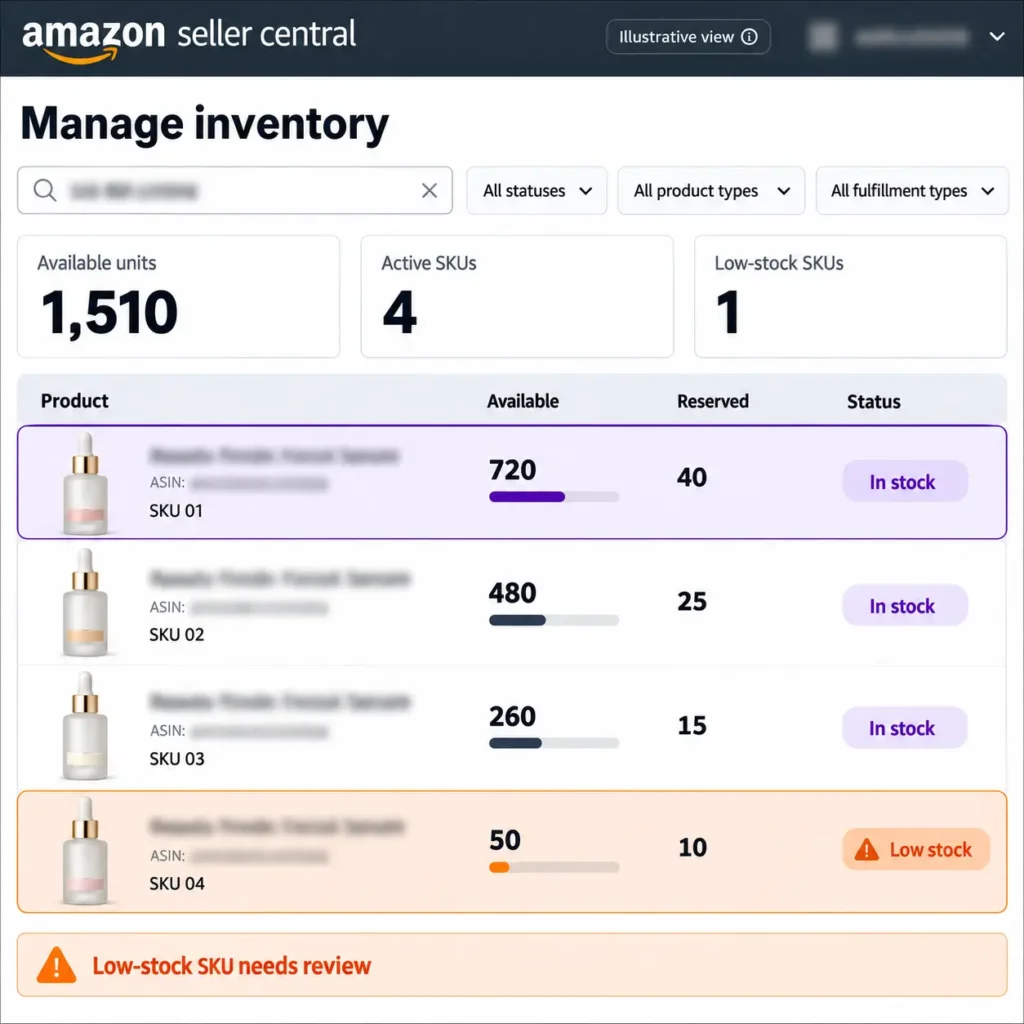
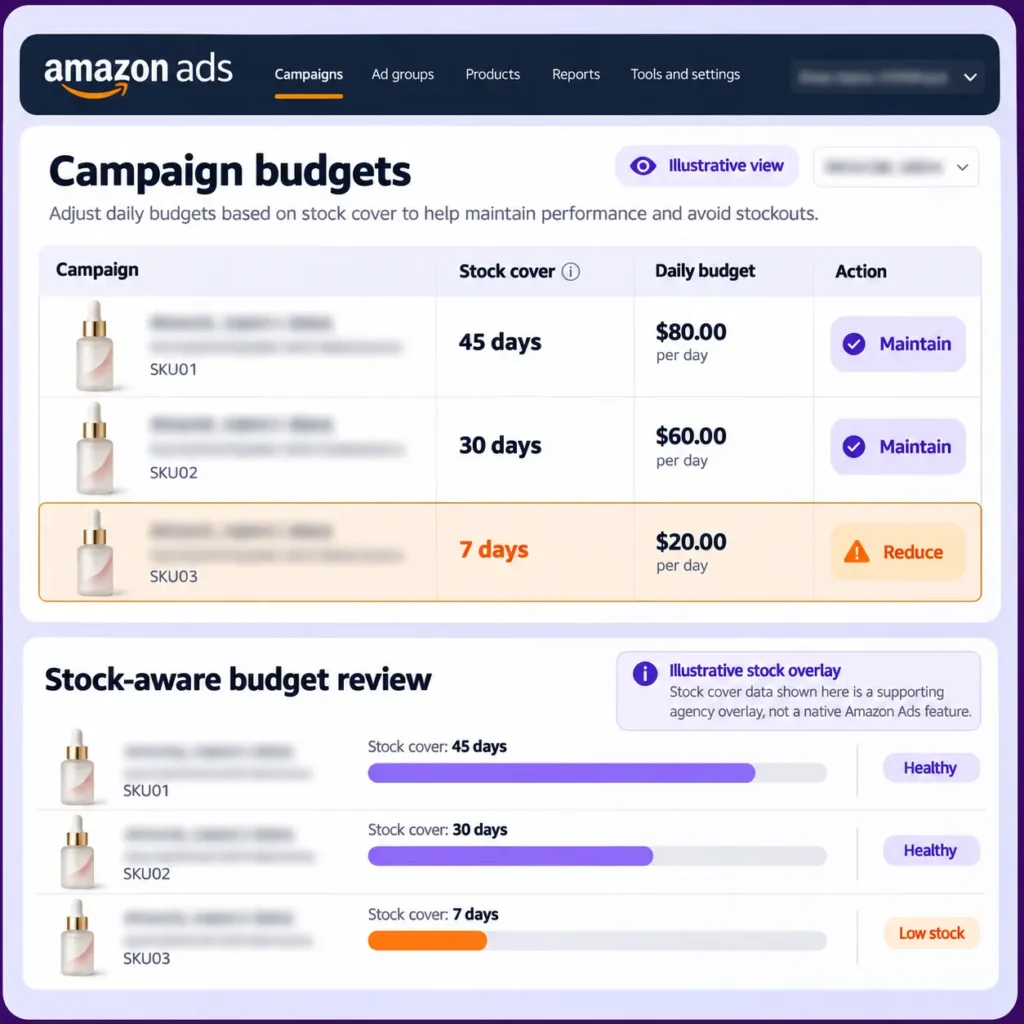
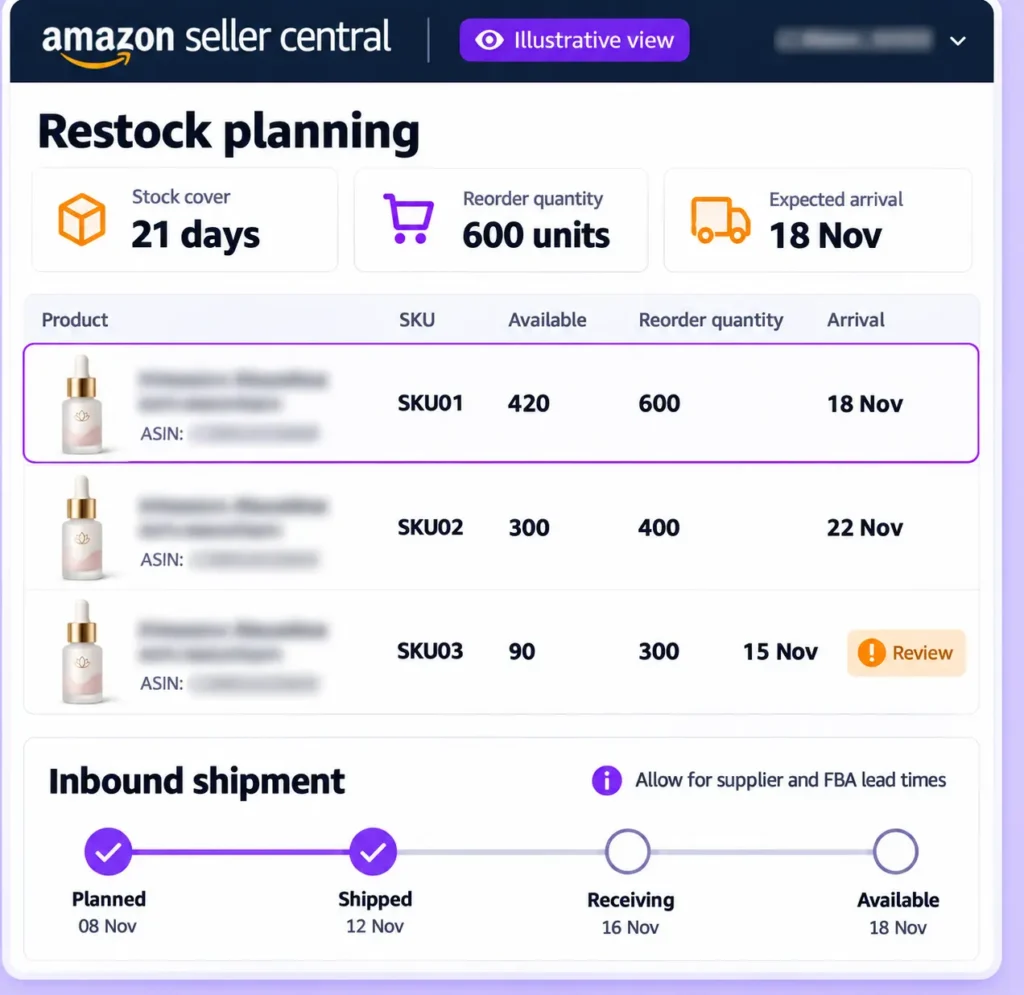
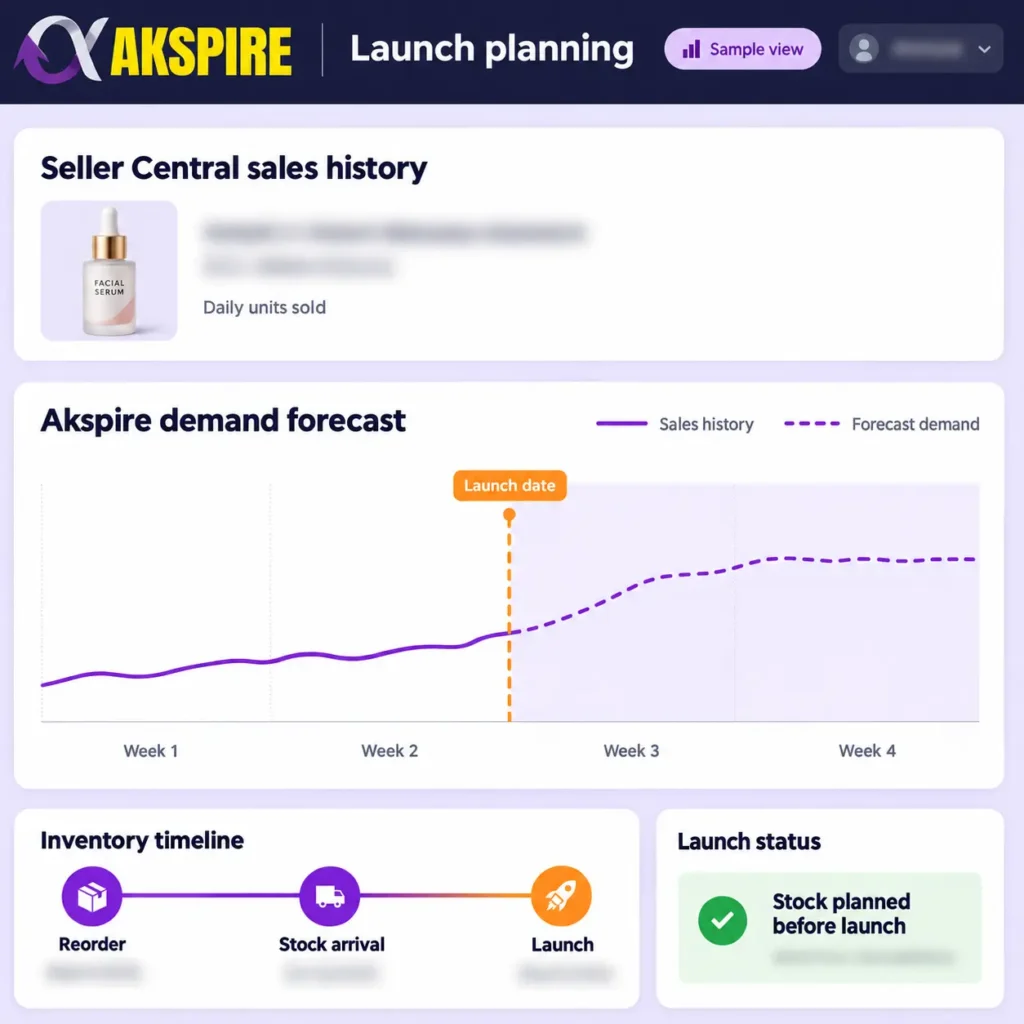
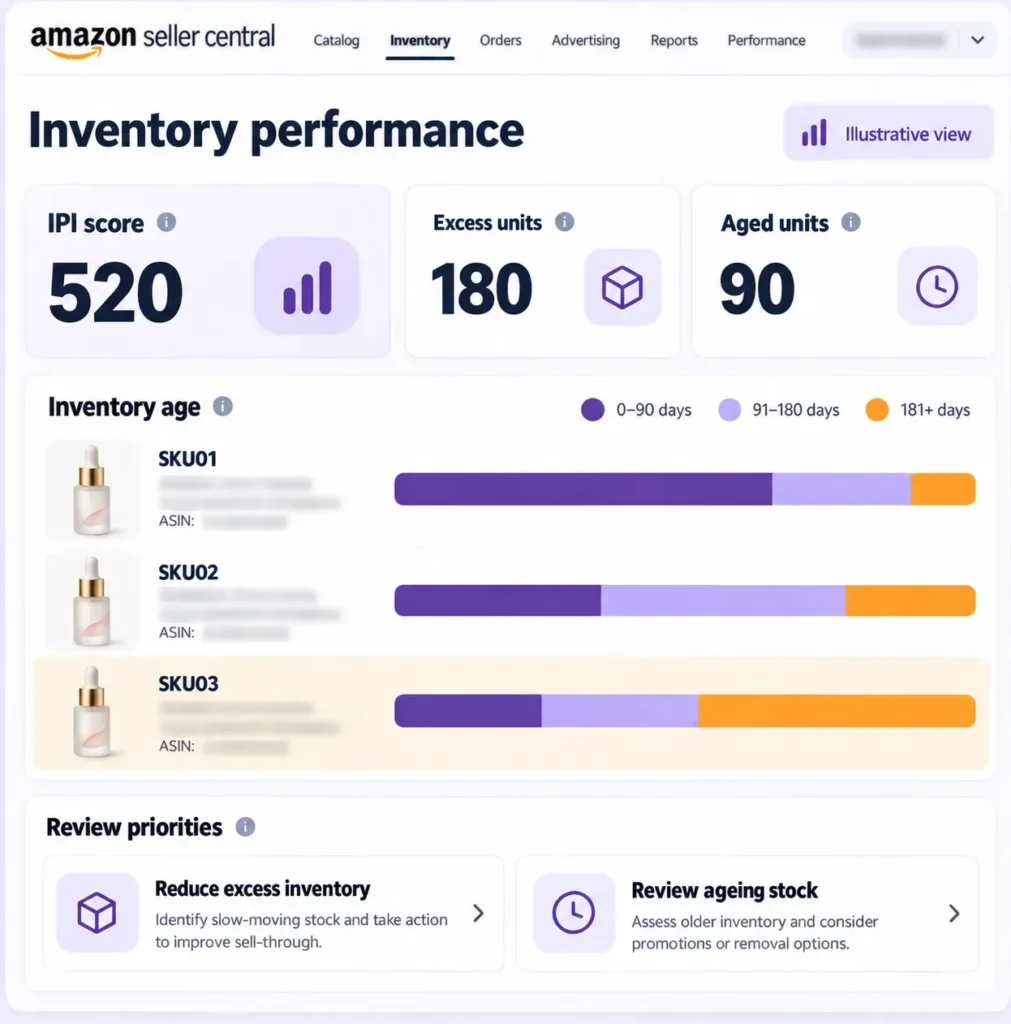
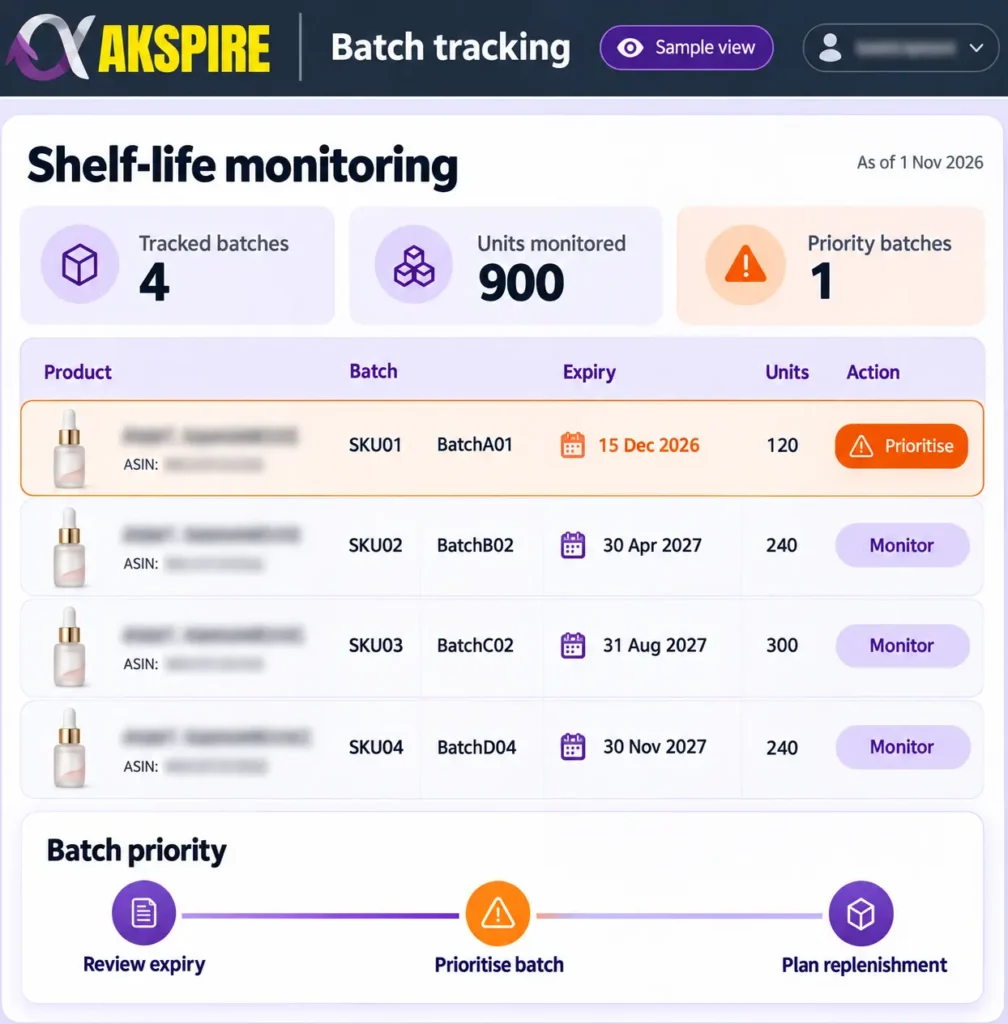
The second view is the one most accounts are missing. Plenty of brands forecast well and still burn budget, because nothing connects the forecast to the campaign that is spending against it.
How it works
How we keep stock and rank protected
1
Forecast demand
Sales velocity projected by SKU, with launches, promotions, seasonality and subscriptions factored in rather than averaged out.
2
Plan restocks
Reorder points and quantities set around your real lead times, and agreed against the cash you actually want tied up in stock.
3
Sync ads to stock
Ad spend scales up or eases back with the stock position, so the budget never drives demand the warehouse cannot meet.
4
Monitor & alert
Levels watched continuously and low cover flagged early, so a reorder decision reaches you while it can still change the outcome.
Step two is where most plans fail, and usually not for forecasting reasons. Restocks get skipped because the cash is not there that month, which is why we agree the reorder budget with you rather than presenting a quantity and assuming it is affordable.
The outcome
What managed inventory delivers
- Rank you keep: no stockout resetting the momentum your ads built.
- Fewer stockouts: forecasts and alerts keep the SKUs that earn available.
- Less expiry waste: dated stock moved in time instead of written off.
- No wasted ad spend: budget never buying clicks you cannot fulfil.
- Lower storage cost: no overstock sitting long enough to attract surcharges.
- Smoother launches: enough stock to feed velocity through the ranking window.
Why AKSpire
Inventory managed by the team spending your ad budget
Ads and inventory, one team
The people managing your spend are the people watching your stock, so the two cannot fall out of sync. Most accounts have these in different tools and different heads, and the gap is where the money goes.
Dated and regulated goods understood
Expiry dates, batch codes and subscription demand are planned for rather than discovered. We work across supplements, food, beauty and other categories where a shelf life decides the reorder, not just the sales rate.
Proactive, not reactive
Risks are flagged before they become stockouts, in days of cover rather than unit counts, because a number of units means nothing without the velocity and the lead time next to it.
One plan, whole account
Inventory ties into sourcing, launch, ranking and advertising rather than sitting in a disconnected tool. The reorder date and the ranking plan are set in the same conversation.
Proven results
Stock kept live, rank kept safe
The unit we plan in, not unit counts
Restock position reviewed
Spend eased before a SKU runs low
Accounts operated to date



Reviews
Amazon Brands That Trust AKSpire
“Our ACoS was eating every bit of profit. AKSpire rebuilt the whole account in a month, now we actually make money on ads and I finally understand the reports.”

Oliver Grant
Co-Founder · Pet Brand
“We launched a new pre-workout with them. Page-one for our main keywords inside the honeymoon window, something two previous agencies never got us.”

Olivia Bennett
Founder · Fitness
“They caught a compliance issue our old agency missed. Listing stayed live through Amazon’s 2026 changes while competitors got suppressed. Worth every dollar.”

Sophia Mitchell
Amazon Growth Manager · Beauty Brand
“We saw improvements in performance under Aleem’s management, and he was a pleasure to work with.”

Mason Reynolds
Founder · Home & Kitchen
“Had a great experience with Aleem and his team, they helped us with ad management and overall amazon strategy.”

Henry Lawson
Director of Marketplace Sales · Beauty Supplements
“Very impressed by Aleem and his team. If you are looking for an amazon expert look no further.”

Aria Peterson
Amazon Advertising Specialist · Clothing Brand
Why not a generalist?
AKSpire vs inventory software vs a separate ads agency
Inventory software is good, cheap and getting better, and we use it. What it cannot do is move your ad budget when the forecast changes.
| Capability | AKSpireniche specialist | Inventory software | Separate ads agency |
|---|---|---|---|
| Ad budget moved with the stock position | Yes | No | Rarely |
| Forecast built around launches and promos | Yes | Partly | No |
| Expiry and batch planning for dated goods | Yes | Some tools | No |
| Reorder budget agreed against your cash | Yes | No | No |
| Capacity and aged inventory watched with fees | Yes | Yes | No |
| Alerts the moment a number changes | Yes | Fastest | No |
| Cost | Flat monthly fee | Lowest | Ads fee only |
Pricing
Simple, profit-aligned pricing
Plans that scale with your account, never more than the profit we’re built to unlock.
Launch
For new brands getting on Amazon the right way.
from $750 /mo
- PPC setup + management
- Launch & ranking playbook
- Compliance-safe listings
Most popular
Growth
For brands ready to scale profitably and defend rank.
from $1500 /mo
- Full PPC + ACoS/TACoS management
- Listing optimization + A+ content
- Custom reporting + strategy calls
Full-Service
Hands-off, done-for-you growth for brands that want it all handled.
Custom
- Everything in Growth
- Product hunting, sourcing & inventory
- Account health, ungating & reinstatement
Get started
Ready to stop stockouts from wrecking your rank?
Start with a free audit. Tell us about your brand and we will come back within one business day, with real next steps and a real person, not an autoresponder.
30 minutes · A real audit, not a pitch · Specialists in your category
- We review your stock & velocity within 24 hours
- You get your teardown: stockout risk by SKU and where the fees are leaking.
- We map your restock plan on a free 30-minute call
Claim your free audit
We only use your details to prepare your audit. No spam, no selling your data. Privacy Policy.
Explore more
Part of a complete operation
Full-Service Amazon Account Management
The whole operation: product research, sourcing, listings, ads, inventory and Seller Central, run end to end by one team.
Store & Account Management
The daily console work that sits alongside this: cases, pricing, promotions and the FBA reconciliation that feeds the stock picture.
Explore →
Sourcing & Launch
Where your lead times come from. The supplier and freight schedule behind every reorder point on this page.
Explore →
Product Hunting & Research
Data-led product and keyword research that finds demand you can actually win profitably.
Explore →
See the whole picture, all AKSpire services →
FAQ
Inventory management: questions answered
Why does inventory matter for PPC?
Because stock and advertising are the same system. Run out and you lose the organic rank your ads paid to build, and Amazon can stop showing the listing entirely. Run low and you are still buying clicks you cannot convert. Managing inventory is part of protecting the advertising investment, which is why the team spending your budget should be the team watching your stock.
What happens to my rank if a SKU goes out of stock?
It falls, and how far depends on how long you were out and how competitive the keyword is. A short outage on an established SKU is usually recoverable. A long one means starting the ranking work again, with advertising spend behind it. Nobody can promise you a full recovery or a timeline for one, and anyone who does is guessing. Preventing it is cheaper than every version of fixing it.
Do you forecast demand?
Yes, by SKU, from your real sales velocity, with launches, promotions, seasonality and subscription demand factored in rather than averaged away. It is still a forecast and it will be wrong sometimes. What we control is the direction of the error: we would rather be slightly short and reorder early than have you carrying six months of stock in a category that moved on.
Do you handle restock timing and IPI?
Yes. Reorder points are worked backwards from your production run length, supplier lead time, freight method and FBA receiving time, not from a generic number of days. We watch the Inventory Performance Index and your capacity allowance together, because capacity is now measured in cubic feet and IPI still feeds into it. We deliberately do not publish a target IPI figure anywhere on this site, because Amazon changes the thresholds and a number in print goes stale.
Can you sync ad spend to my stock levels?
That is the core of the service. Budgets ease back as days of cover drop and scale again once a shipment is received and checked in, so spend never drives demand the warehouse cannot meet. It is also one of the quieter ways to lower cost per sale, because budget stops going to SKUs that cannot convert and moves to the ones that can.
Do you account for shelf life and expiry dates?
Yes, for supplements, food, beauty and anything else with a date on it. Planning is batch aware, oldest stock sells first, and reorders are sized so a shipment is not racing its own expiry date. Amazon requires a minimum remaining shelf life on dated goods at the point they are received, and that requirement varies by category and gets revised, so we work to your current category rules rather than a number printed on a page.
Do you place the purchase orders?
No. We produce the reorder point, the quantity and the date it needs to be placed by, and you or your supplier contact place it. We do not touch your money or commit you to a purchase order, and we take no commission on what you order. If you want the supplier side handled as well, that is sourcing and launch rather than this service.
Does this work if I use a 3PL, or fulfil the orders myself?
Yes, and the forecasting and ad-spend sync are identical. What changes is the lead-time maths and which fees matter. If you are merchant fulfilled or shipping from a 3PL you avoid FBA storage and capacity pressure but take on your own handling times and the risk that a late dispatch hits your account health. We plan to whichever model you actually run, including a mix of both.
Free PPC Audit
Find the stockout before it finds you.
Send us your stock position and we will come back with days of cover by SKU, which products your ads are currently spending against too hard, and where storage and capacity costs are leaking. No fluff, no obligation.
Written audit · 3 business days · Complimentary · No sales pitch.