
Key Takeaways
What Amazon has actually published about duplicate keywords across your own campaigns, and the structure that holds up whichever way the auction works.
- Amazon’s English documentation is silent on self-competition. No page on the Amazon Ads site states which of your campaigns serves when the same keyword sits in several.
- Amazon’s Chinese Global Selling FAQ says campaigns in one account do not compete, which is the opposite of what almost every agency article asserts without a source.
- The conflict Amazon does document is budget, not bids. Keywords sharing a campaign share its budget, and a campaign that runs out at midday stops serving all of them.
- The strongest structural argument is one Amazon states plainly: bids apply to every product in an ad group, so mixed ad groups cannot be bid correctly.
- Build a structure that is right either way. Negative exact gating, single-theme ad groups and placement control all work whether or not self-competition is real.
Search for Amazon PPC campaign structure and every result tells you the same thing: put the same keyword in two campaigns and they will bid against each other, driving up your own cost per click. It is repeated so consistently that it reads as settled fact.
I went looking for the Amazon source. There is not one.
What exists instead is more interesting, and it changes what a sensible campaign structure looks like. Amazon’s English documentation does not address the question at all. Amazon’s Chinese-language Global Selling FAQ addresses it directly and says the opposite of the consensus. An Amazon forum moderator was asked and declined to answer. Meanwhile, the one structural problem Amazon does document clearly is a different problem entirely, and most account structures are not built for it.
This is written for a seller who already runs several campaigns and suspects they are working against each other. You will finish it knowing what is established, what is folklore, and which structure is robust to both.
Quick Verdict: what is actually true
Nobody can show you Amazon saying your campaigns bid against each other. I checked the Sponsored Products best practices guide, the targeting guide, the keyword strategy blog and the advertising FAQ. All silent.
Amazon’s own Global Selling FAQ says the opposite, in Chinese: campaigns within the same account do not create a competitive relationship, and the system determines which match applies.
The real documented cost of duplication is budget and measurement, not bid inflation. That is a cheaper problem to fix and a different structure solves it.
What has Amazon actually said about duplicate keywords?
Less than the industry implies, and what it has said points the other way.
On Amazon’s English-language advertising site, the pages where this would naturally appear say nothing about it. The Sponsored Products best practices guide covers campaign structure in detail without mentioning duplicate keywords across campaigns. The targeting guide covers match types and negatives without addressing it. The advertising FAQ does not raise it.
On globalselling.amazon.com, which is Amazon-operated, the Chinese-language advertising FAQ addresses it twice. It states that ad campaigns within the same account do not create a competitive relationship. Asked directly whether the same word in all three match types will bid against itself, the answer given is no, and that the system determines which match applies. A second Amazon page on the same domain repeats that campaigns under the same account do not compete with each other.
Two caveats before you lean on that. It is the China Global Selling FAQ rather than the US ads site, and auction behaviour is not guaranteed to be identical across marketplaces. And it is a translation, so the precise force of the wording is worth treating carefully.
Amazon’s own community does not resolve it either. In one Seller Forums thread asking this exact question, an Amazon moderator replied “This is a very good question, and I am commenting here so it becomes more visible,” then directed the seller to Ads support without answering. In two other threads no Amazon staff replied at all, and sellers gave flatly contradictory answers to each other.
That is the complete evidence base behind a rule most agencies state as fact.
What is the real cost of duplication then?
Two things, both documented, and neither is bid inflation.
Shared budget. Keywords inside one campaign draw on that campaign’s daily budget. A campaign that exhausts its budget at midday stops serving every keyword in it, including the one that was profitable. Group ten terms with very different conversion rates into one campaign and the weak ones consume budget the strong ones needed. This is the conflict that genuinely happens inside an account, and it is a budget architecture problem rather than an auction problem.
Measurement. Amazon’s own guide to common sponsored ads mistakes lists “inefficient campaign structuring” and names the symptom precisely: campaigns built “without clear naming conventions, mixed targeting types, overlapping targeting, and scattered ASINs make it difficult to effectively track performance.” Note what Amazon says the cost is. Difficulty tracking performance. Not a bidding war with yourself.
That distinction matters because the fixes are different. If the problem were bid inflation, the answer would be ruthless deduplication. If the problem is budget contention and measurement, the answer is isolation by theme and intent, which is a better structure anyway.
What is the strongest structural rule Amazon does state?
This one, and it is the reason to isolate that nobody quotes: “Keyword or product targeting, and bids apply to all products within an ad group.”
Read that again, because it is the whole argument. One bid covers every product in the ad group. If you have a 19 dollar product and a 79 dollar product in the same ad group, there is no bid that is correct for both. The cheap one is overbid and loses money, the expensive one is underbid and loses position. No amount of optimization fixes it, because the control does not exist at the level you need it.
Amazon reinforces this with two more specific rules in the same guide. “Only include ASINs from the same category in one campaign.” And “group ASINs based on price range and conversions within the same category.”
That is a complete structural mandate from the primary source, and it has nothing to do with cannibalisation. Build to it and you get single-theme ad groups, which happen to also solve the budget contention problem.
This is also why a restructure is usually worth more than a bid overhaul on an account that has grown organically. Campaigns accumulate around whatever the catalogue looked like two years ago, and the bid logic underneath them stops matching the products inside them. A deliberate keyword and search-term strategy built on price band and conversion rate fixes the control problem at its root rather than compensating for it every week.
Two practical limits worth knowing from the same page: you can add 1,000 products to an ad group at a time, and Amazon recommends starting at a 10 dollar daily budget. Portfolios exist to organise campaigns “by brand, category, season, or any way you choose.”
What structure works whichever way the auction behaves?
Build it so the cannibalisation question becomes irrelevant. Five rules.
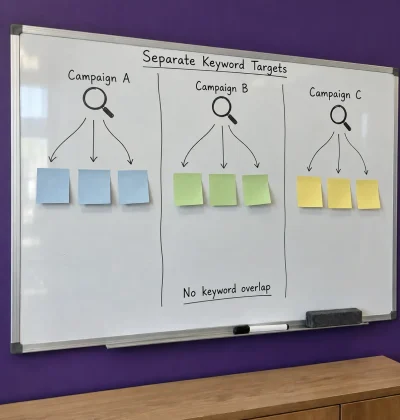
One theme per ad group, one bid logic per theme. Because bids apply to every product in the ad group. Split by price band and conversion rate within a category, not by whatever grouping the catalogue happened to arrive in.
Gate with negative exact rather than hoping the auction sorts it. Amazon’s targeting guide explicitly recommends “using phrase or exact match with negative keywords,” and defines negative exact as preventing ads showing “on shopping queries that contain the exact phrase or close variation.” If you want a term served by your exact campaign and not your broad one, negative exact it out of broad. That is a control you hold, not an assumption about auction behaviour.
One caveat on harvesting, from Amazon. The same Global Selling page that says campaigns do not compete also recommends against negating high-performing keywords out of automatic campaigns. That contradicts the standard agency habit of harvesting winners from auto and negating them out. Worth testing on your own account rather than applying either rule on faith.
Use placement control, which is a real and large lever. Advertisers can adjust bids for top of search, product pages and rest of search, and Amazon states the rest of search control works “same as the other two placements,” adjustable “by up to 900%.” Three placements, each adjustable up to 900%. That is a far bigger lever than deduplication and almost nobody uses it deliberately.
Separate budgets by job, not by keyword. Brand defence, category prospecting and competitor conquesting have different acceptable costs. Give each its own campaign and its own budget so a bad week in one cannot starve the others.
One hard constraint to plan around: Amazon’s Global Selling FAQ states you cannot convert an active automatic-targeting campaign to manual targeting, or the reverse. Structure decisions made at setup are not easily undone, which is an argument for getting segmented, single-theme campaigns right the first time.
Quick Verdict: what to do this week
- Stop deduplicating on faith. If you are negating terms out of campaigns purely to prevent self-competition, you are acting on an unsourced rule and may be removing reach.
- Split any ad group holding products at different price points. One bid covers them all, which means one of them is always wrong. This is the fix with the clearest primary-source backing.
- Audit which campaigns go out of budget before the day ends. That is the duplication cost that is definitely real, and it is visible in your own reports today.
- Set placement adjustments deliberately. Three placements, up to 900% each, and most accounts have never touched them.
Does this mean duplicate keywords are fine?
No, and the honest answer is that nobody outside Amazon knows the auction mechanics well enough to say.
What can be said is this. The cost of duplication that is documented is budget contention and measurement difficulty. The cost that is asserted everywhere, bid inflation against yourself, has no source and one Amazon page contradicting it. So the rational position is to structure against the documented costs, which produces a clean account anyway, and to stop paying for aggressive deduplication sold on an unproven mechanic.
There is one more reason to avoid heavy duplication that has nothing to do with auctions. Every duplicate makes your reporting worse. When the same term runs in four places, no single report tells you what that term is worth, and the decision you need to make about it becomes a reconciliation exercise.
If you want a precise answer on the auction, the only honest route is testing it on your own account with a controlled before and after, and accepting that the result applies to your account rather than to Amazon generally.
How do you test it on your own account?
A simple design, run over four weeks.
Pick one keyword that currently runs in three campaigns with meaningful spend. Record its baseline for the previous 28 days: impressions, clicks, average cost per click, spend, orders and ACoS, in each campaign and in total.
Negative exact it out of two of the three so it serves from one campaign only. Change nothing else. No bid moves, no budget moves, no new negatives elsewhere.
After 28 days compare the total, not the survivor. If the consensus is right, total cost per click should fall and total orders should hold. If Amazon’s Global Selling FAQ is right, total cost per click should be roughly unchanged and total impressions may drop, because you have removed entry points rather than resolved a bidding conflict.
Run it on one term before you run it on a hundred. And do not run it during a launch, a stockout or a deal period, because all three break the baseline.
What it comes down to
The most repeated rule in Amazon PPC campaign structure has no Amazon source, and the one Amazon page that addresses it directly says the opposite. That is worth knowing before you pay anyone to restructure an account around it.
What Amazon does state is enough to build on. Bids apply to every product in an ad group, so isolate by price band and conversion rate. Keep ASINs from one category per campaign. Use negative exact as a deliberate gate. Set placement adjustments, which are a far larger lever than deduplication.
Structure for budget and measurement and you get a clean account whether or not your campaigns ever competed. Structure for cannibalisation alone and you have optimised against a rule nobody can show you.
Frequently Asked Questions
Do my own Amazon campaigns bid against each other?
Amazon’s English documentation does not say. Its Chinese-language Global Selling FAQ states that campaigns within the same account do not create a competitive relationship, and that the system determines which match applies. An Amazon forum moderator asked this directly declined to answer. Treat any confident claim either way as unsourced.
Should I negative keyword winners out of my auto campaign?
Opinions differ and so do Amazon’s own pages. Standard agency practice is to harvest converting terms from automatic campaigns into manual ones and negate them out of auto. Amazon’s Global Selling guidance recommends against negating high-performing keywords in auto campaigns. Test it on your account rather than applying either rule universally.
How many products should go in one ad group?
Group by price band and conversion rate within a single category, not by count. Amazon states that bids apply to all products within an ad group, so mixing a 19 dollar product with a 79 dollar one guarantees one is bid wrong. Technically you can add 1,000 products at a time, but that is a limit, not a recommendation.
What is the difference between negative phrase and negative exact?
Negative phrase stops ads showing on shopping queries that contain the complete phrase or close variations. Negative exact stops them only on queries containing the exact phrase or a close variation. Negative phrase is broader and riskier. Use negative exact when gating a specific term between your own campaigns.
Can I change an automatic campaign to manual targeting?
No. Amazon’s Global Selling FAQ states you cannot change an active automatic-targeting campaign to manual targeting, and you cannot change an active manual campaign to automatic. The targeting type is fixed at creation, which makes initial structure decisions more consequential than most sellers expect.
Resources and further reading
The following sources were used to inform and validate this article.
- Amazon Ads: Best practices for your Sponsored Products ads. The statement that bids apply to all products within an ad group, the single-category campaign rule, and the price band and conversion grouping guidance.
- Amazon Ads: A guide to targeting with Sponsored Products. Match type definitions, Amazon’s recommendation to pair phrase or exact with negatives, and the negative phrase versus negative exact distinction.
- Amazon Ads: Common sponsored ads mistakes and solutions. Amazon naming overlapping targeting as a structural mistake, and framing its cost as difficulty tracking performance.
- Amazon Global Selling advertising FAQ. Amazon-operated, Chinese language. States that campaigns within one account do not create a competitive relationship, and that targeting type cannot be changed after creation.
- Amazon Ads: Rest of search bid adjustment for Sponsored Products. Confirmation of three adjustable placements, each adjustable by up to 900%.