Key Takeaways
A dependency ordered launch checklist built from Amazon’s published requirements, ending at the one gate that decides whether advertising can run at all.
- Advertising has a hard prerequisite most checklists treat as a parallel task. Amazon states that to advertise, your product must be eligible to be the featured offer.
- Delivered does not mean sellable. Units become available for sale at Receiving status, not when the carrier drops the pallet, and Amazon publishes no typical receiving duration.
- Amazon’s title cap and its advertising title guidance are different numbers. The policy limit is 200 characters, the advertising recommendation is around 60.
- The honeymoon period is not an Amazon policy. An Amazon representative stated on Amazon’s own forums that no official documentation or policy confirms it.
- Several incentives expire 90 days after listing, which makes the launch clock a real deadline rather than a preference.
Most Amazon launch checklists are organised by phase: pre-launch, launch day, post-launch. That looks tidy and it hides the thing that actually determines whether a launch works, which is dependency. Several items cannot be started until another is finished, and a checklist that lists them side by side will let you discover that in the wrong week.
This one is ordered by what blocks what. It ends where it should end, at advertising eligibility, because Amazon is explicit that a product which cannot be the featured offer cannot be advertised at all. Everything above that line exists to get you through that gate.
Where a requirement comes from Amazon, I have said so. Where a number is industry convention rather than an Amazon rule, I have said that too, because the two get blended constantly and only one of them is enforceable.
Quick Verdict: the four hard gates
Gate one, Brand Registry. A registered or pending trademark unlocks A plus content, Brand Store, Sponsored Brands and Vine. Nothing downstream of it can be faked.
Gate two, inventory received. Amazon states received units are available for sale at Receiving status. Delivered is not the same thing, and Amazon publishes no typical duration for this step.
Gate three, featured offer eligibility. Amazon states that to advertise, your product must be eligible to be the featured offer, and that products need to be in stock to qualify.
Gate four, the listing itself. Amazon recommends advertising products with five or more reviews at 3.5 stars, four or more zoomable images and at least three bullets. That is Amazon’s own bar.
Phase 1: Account and brand, items 1 to 8
Nothing below this phase can start until these are done.
- Professional selling plan active. Amazon states advertising requires an active professional seller or vendor account, and lists the Professional plan at 39.99 dollars a month plus selling fees.
- Trademark registered or application filed. Amazon requires “an active, registered trademark or a pending trademark application for your brand name or logo.”
- Trademark is a word mark or a design mark containing words, letters or numbers. Amazon accepts those two types.
- Brand name and logo permanently affixed to product or packaging. Amazon states this requirement explicitly, and it blocks unbranded white label.
- Brand Registry enrollment submitted under the trademark owner’s account. Agencies cannot enrol on your behalf.
- GTIN or UPC obtained, or GTIN exemption applied for. Exemptions are not available where a GS1 approved barcode already exists on the product.
- Category approval checked. In Seller Central, an Apply to sell button means you are gated; Sell this product means you are not.
- Restricted or prohibited status confirmed for your category, including any required certifications or documentation.
Items 2 to 5 are the long pole. A trademark application can take months, and everything in Phase 4 depends on it.
Phase 2: Product and packaging, items 9 to 16
- Final samples approved against your written spec.
- Packaging drop tested, because transit damage is one of the most common early review complaints and it is a packaging problem.
- Instructions written and tested on someone who has never seen the product.
- Sizing or fit variance resolved where relevant.
- Required certifications obtained. Dietary supplements require cGMP certification and FDA registration; over the counter drugs require FDA registration and proper labeling.
- Safety data sheet prepared if the product is classed as a dangerous good.
- Supplier invoices retained. Category approval commonly requires invoices showing purchase of 10 or more units.
- Brand authorization letter obtained if you are not the brand owner.
Treat 9 to 12 as hard stops. Items that are still changing at this stage produce reviews you cannot remove later.
Phase 3: Listing build, items 17 to 28
- Title within 200 characters including spaces, which is Amazon’s policy limit.
- No word repeated more than twice in the title, excluding prepositions, articles and conjunctions.
- No restricted special characters in the title unless part of the brand name.
- Title also written to work at around 60 characters, which is Amazon’s advertising recommendation. These are two different numbers for two different purposes.
- Up to five bullet points written, which is Amazon’s stated ceiling. Amazon’s advertising guidance asks for at least three.
- Product description written. Amazon’s position is that you should always write descriptions.
- Backend search terms completed.
- Main image on a pure white background, RGB 255,255,255.
- Product fills 85% or more of the main image frame. Note Amazon Ads separately recommends 80% of the image area, so these are two different guidelines from two Amazon teams.
- Images at least 1,000 pixels on the longest side to enable zoom. The acceptable range is 500 to 10,000 pixels.
- Four or more images showing different angles, per Amazon’s advertising guidance. Amazon separately recommends at least six images plus one video, with up to nine photos permitted.
- Variations and parent child relationships set correctly.
Getting the keyword work right here is cheaper than fixing it after launch, which is why listing SEO and keyword indexing belongs in this phase rather than in month two.
Phase 4: Brand features, items 29 to 33
All of these are downstream of Brand Registry.
- A plus content built and submitted.
- Brand Store built, if you have enough catalogue to justify one.
- Sponsored Brands eligibility confirmed.
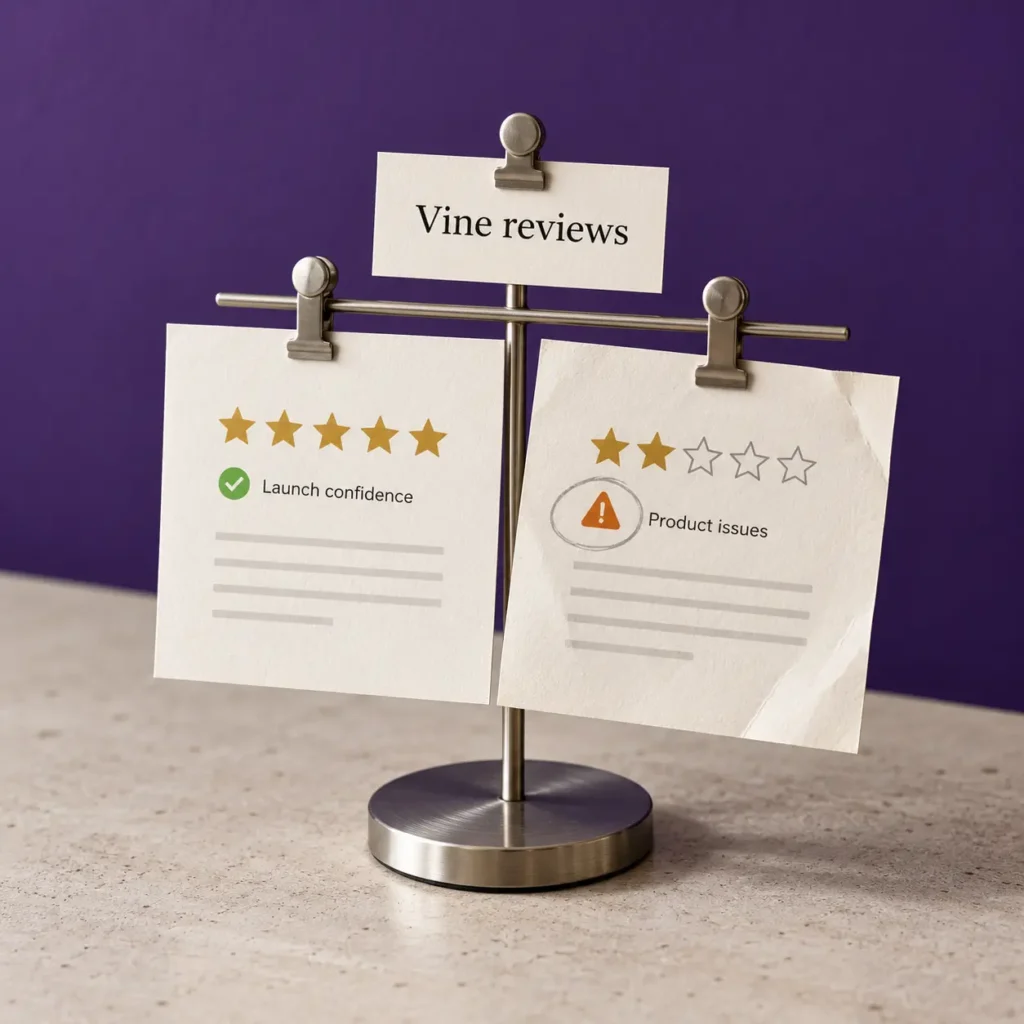
- Vine enrollment prepared, requiring an FBA listing and fewer than 30 existing reviews.
- Vine unit count decided. Up to 2 units is free, 3 to 10 costs 75 dollars, 11 to 30 costs 200 dollars.
One honest note on A plus content. It improves conversion and Amazon does not index its text for search. Anyone selling it to you as an SEO play is wrong about what it does.
Phase 5: Inventory, items 34 to 38
- Shipment created in Send to Amazon, with the ship date set to when you hand off to the carrier.
- Shipping labels and FBA box ID labels applied, one per box.
- Tracking supplied in Seller Central for non-partnered carriers, or a valid bill of lading provided for pallet shipments.
- Inventory available in the fulfillment network at least three weeks before your planned launch date, which is Amazon’s own recommendation for Vine.
- Shipment status tracked to Receiving. This is the item most launches get wrong.
That last one deserves expanding. Amazon’s shipment statuses are distinct and only one of them means sellable. Delivered means the shipment has arrived or is at an Amazon location but not yet checked in. Checked in means it has moved to the dock. Receiving begins when Amazon scans the first shipment label, and Amazon states that received units are available for sale, though not necessarily available for immediate shipping while stock is redistributed.
Amazon publishes no typical duration for receiving. It does note that “a shipment might be checked in several days after the date it arrives at an Amazon location,” and that it can take longer during high volume periods. Any specific day count you have been given for this step is convention, not an Amazon figure.
Phase 6: Advertising readiness, items 39 to 41
These are the gate.
- Featured offer eligibility confirmed. Amazon states that “in order to advertise, your product must be eligible to be the featured offer,” and that “your products need to be in stock in order to be the featured offer.” Amazon’s advice is to make sure you are winning the featured offer at the highest rate, “ideally 90% or higher.”
- Listing meets Amazon’s advertising quality bar: five or more reviews at 3.5 stars or higher, four or more zoomable images, at least three bullet points. At launch you will not have the reviews, which is the chicken and egg problem Vine exists to solve.
- Campaigns built and budgets set. Amazon suggests “just 10 dollars a day can help you get clicks and sales,” and recommends starting with the suggested bid before adjusting.
Amazon’s own new ASIN guidance puts the sequence in exactly this order, advising sellers to “review your product detail pages, inventory levels, and pricing before launching campaigns.” A launch readiness audit against items 39 to 41 before spending anything is the cheapest insurance in the whole list.
Quick Verdict: what to check in the final week
- Is the shipment at Receiving, not just Delivered? Those are different statuses and only one means your units can sell.
- Are you winning the featured offer at 90% or higher? Amazon names this as the benchmark, and below it your ads are serving less than you think.
- Is anything about the product still changing? If packaging, sizing or instructions are in flux, delay Vine rather than delaying the fix.
- Have you set a baseline? Record impressions, clicks, cost per click and conversion rate before day one, or you will have nothing to measure against.
What about the honeymoon period?
It is not an Amazon policy, and that is worth knowing before you build a launch plan around it.
Asked directly on Amazon’s Seller Forums for official documentation on how new launches are treated, an Amazon representative replied that there is no official Amazon documentation or policy that confirms a honeymoon period. The term does appear once on Amazon’s own blog, but inside a quotation from a named third-party seller describing his own practice, not in Amazon’s editorial voice.
What the Amazon representative did describe, in that same thread, is more useful and less magical. New products can qualify for a New Release badge. Amazon uses early engagement signals such as clicks, purchases and reviews to judge relevance, so products that perform early may rank better. Organic visibility typically takes one to three months to stabilise, and advertising is often the main early traffic source.
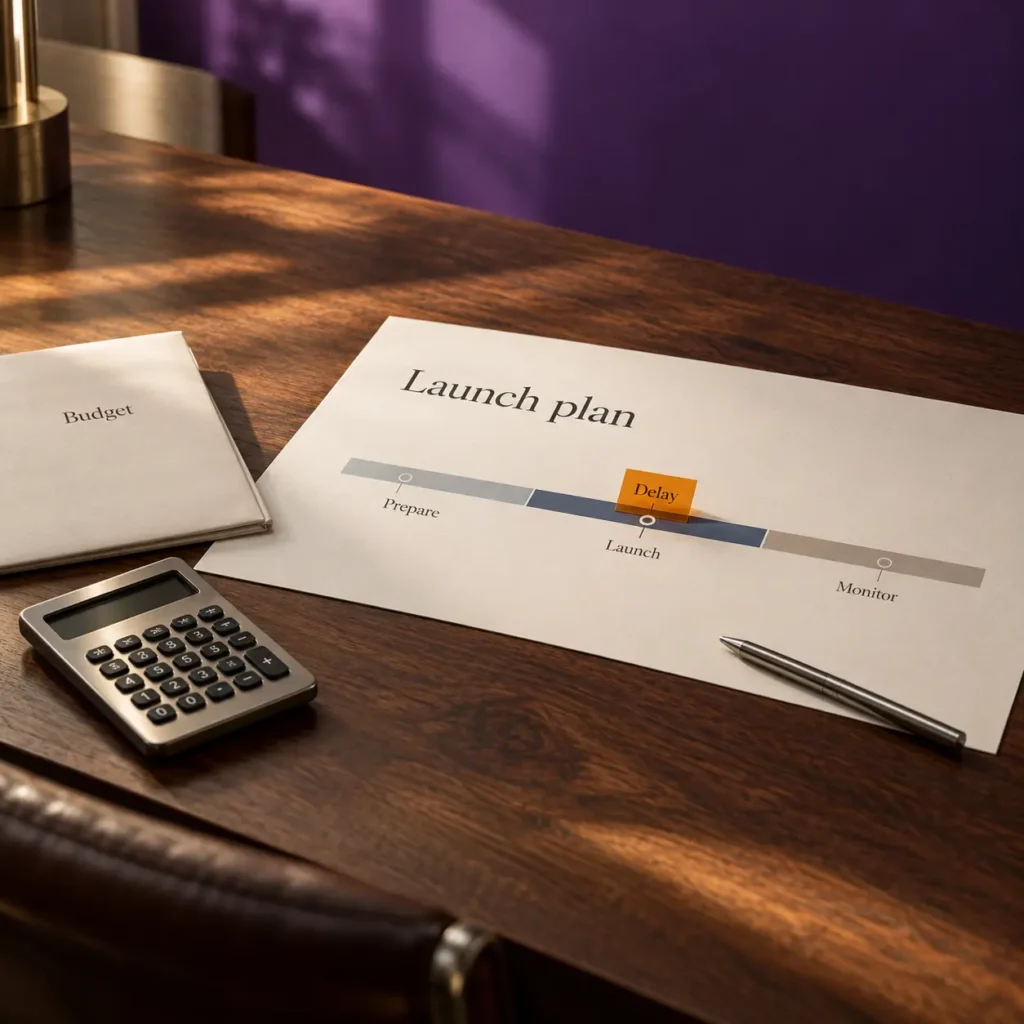
That is a mechanism rather than a granted window, and it changes what you do. You are not racing a timer that closes at day 30. You are generating the engagement signals that determine where the product settles over one to three months, which means a launch that starts slightly late with a complete listing beats one that starts on time with a half built one.
What deadlines are actually real?
Several, and they key off your listing date rather than your launch date.
Amazon’s new seller incentives repeatedly use a 90 day window from listing: creating your first FBA shipment, enrolling a product in Vine after Brand Registry, creating a Sponsored Products campaign, and creating a coupon. Advertising credits carry a further condition, requiring the credit to be spent within 30 days of campaign launch.
The FBA New Selection program adds its own terms: free storage for the first 200 units of each new parent ASIN for 120 days after it is received, with an Inventory Performance Index of 300 or higher required for eligibility, and automatic enrollment for new sellers who create a first shipment within 90 days.
Those are the real deadlines. Note that none of them is a ranking window. They are commercial terms, they are published, and missing them costs money rather than position.
What this comes down to
A launch checklist works when it is ordered by dependency rather than by phase, because the failures are almost always sequencing failures. The trademark that was not filed early enough. The shipment that was delivered but not received. The campaign that went live against a listing which could not win the featured offer.
Amazon publishes more of this than sellers realise. The featured offer requirement, the 90% benchmark, the image and bullet thresholds, the shipment statuses, the incentive deadlines. What Amazon does not publish is a honeymoon period, a typical receiving duration, or a launch budget figure, and any checklist that states those with confidence has filled a gap with folklore.
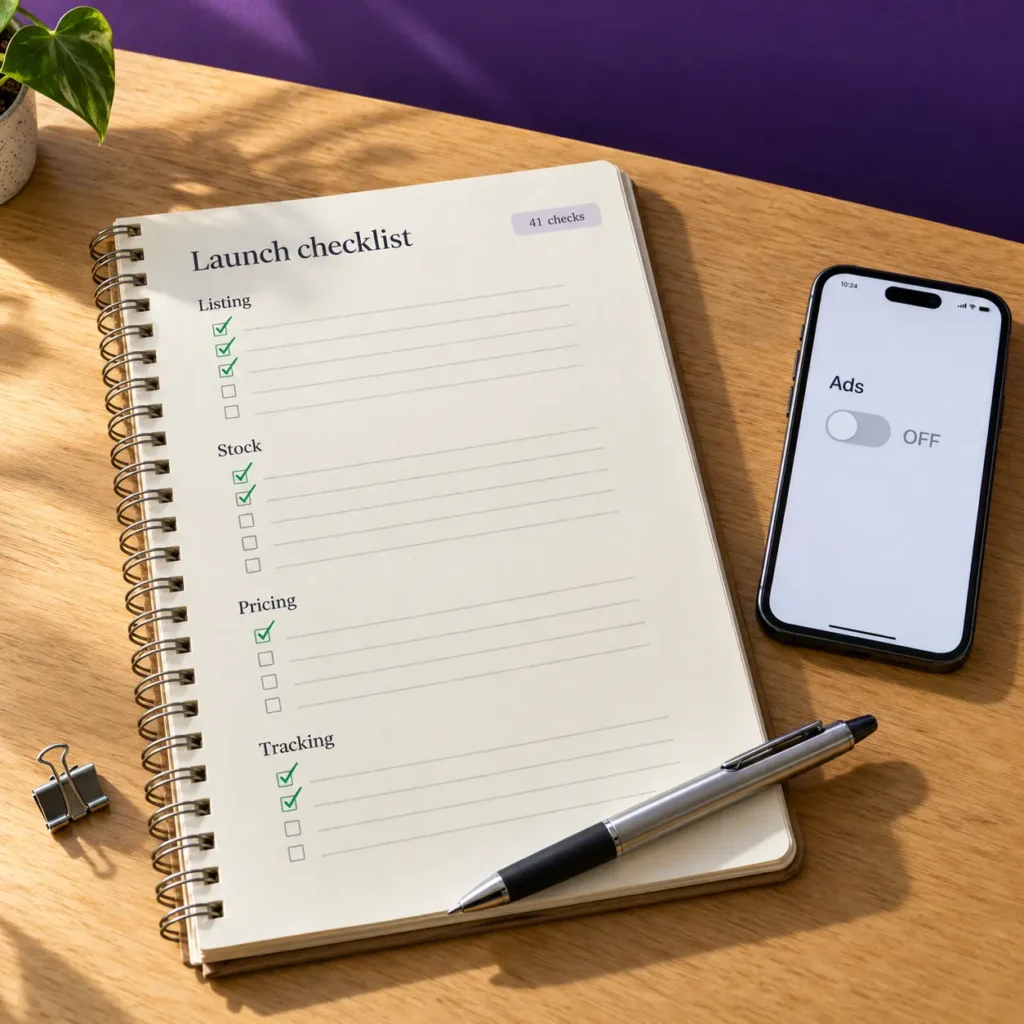
Work down the 41 items in order. Treat item 39 as the gate it is, and do not spend a dollar on advertising until it is green.
Frequently Asked Questions
What has to be done before I can advertise a new Amazon product?
Your product must be eligible to be the featured offer, which Amazon states requires being in stock. Beyond that, Amazon recommends advertising products with five or more reviews at 3.5 stars or higher, four or more zoomable images and at least three bullet points, with the featured offer won at 90% or higher.
When does FBA inventory become sellable?
At Receiving status, which Amazon says begins when it scans your first shipment label. Delivered and Checked in are earlier statuses and do not mean your units can sell. Amazon notes received units are available for sale but may not ship immediately while stock is redistributed, and publishes no typical receiving duration.
Is the Amazon honeymoon period real?
Not as Amazon policy. An Amazon representative stated on Amazon’s Seller Forums that no official Amazon documentation or policy confirms a honeymoon period. What the representative described instead is a New Release badge plus early engagement signals, with organic visibility typically taking one to three months to stabilise.
How long should my Amazon product title be?
Amazon’s policy limit is 200 characters including spaces, with no word repeated more than twice excluding prepositions, articles and conjunctions. Amazon’s advertising guidance separately recommends titles of approximately 60 characters. Write for the advertising recommendation and stay within the policy cap.
How many images does an Amazon listing need?
Amazon permits up to nine photos and recommends at least six plus a video. Its advertising guidance asks for four or more showing different angles. The main image needs a pure white background at RGB 255,255,255, with the product filling 85% or more of the frame, and at least 1,000 pixels on the longest side for zoom.
Resources and further reading
The following sources were used to inform and validate this article.
- Amazon Ads: Improve your products for advertising. The featured offer requirement for advertising, the in-stock condition, image and bullet thresholds, and the 60 character title recommendation.
- Amazon Ads: New advertiser success guide. The 90% featured offer rate benchmark, the review and rating threshold, and the 10 dollar a day starting budget.
- Amazon: FBA shipment tracking. Definitions of In transit, Delivered, Checked in and Receiving, and confirmation that received units are available for sale.
- Amazon: Brand Registry. The registered or pending trademark requirement, accepted mark types, the permanently affixed branding rule, and what enrollment unlocks.
- Amazon Seller Forums: Honeymoon period for new brands and launches. An Amazon representative stating that no official documentation or policy confirms a honeymoon period.
- Amazon: New seller incentives. The 90 day from listing windows for FBA shipments, Vine enrollment, Sponsored Products campaigns and coupons.