Key Takeaways
Why the average Amazon CPC figures in circulation are unsourced, what genuinely drives your cost per click, and nine levers you control.
- Amazon states plainly that “there won’t be a set number for the CPC of a brand’s ad.” Every blog quoting an average Amazon CPC is quoting something Amazon has never published.
- Your bid is not your cost. Amazon says the final CPC “is based on your adjusted bid plus additional factors” and that the auction considers factors beyond bid.
- The demand-side pressure is real and measurable. Amazon’s advertising net sales reached 19.6 billion dollars in Q3 2026, up 11% year over year, which is more money chasing the same impressions.
- Three placements are each adjustable by up to 900%, and most accounts have never set them. That is the single largest unused lever in Amazon PPC.
- The cheapest click is the one you do not need, which makes conversion rate a CPC lever even though it changes nothing about bidding.
Search for Amazon PPC cost and you will find a dozen pages quoting an average cost per click somewhere between 80 cents and 1.30 dollars. None of them cites Amazon, because Amazon has never published the figure.
Amazon’s own cost per click guide is explicit: “there won’t be a set number for the CPC of a brand’s ad.” That one sentence invalidates the premise of most of the category’s content, and it is the right place to start, because you cannot manage a cost against a benchmark that does not exist.
What follows is what actually sets your cost per click, the honest version of whether CPCs are rising, and nine levers that change your cost rather than your anxiety about it. Written for a seller watching cost per click climb whose only response so far has been lowering bids.
Quick Verdict: the three things that matter most
Your bid is a ceiling, not a price. Amazon states the maximum CPC “is the highest amount an advertiser could be charged for a click,” with the final cost determined by an auction considering factors beyond your bid.
Placement adjustment is the biggest unused lever. Three placements, each adjustable by up to 900%. Most accounts run all three at default and then complain about blended cost.
Conversion rate is a cost per acquisition lever disguised as a listing problem. Lifting conversion does not lower your CPC, but it lowers what each sale costs, which is the number that actually matters.
Is Amazon cost per click really rising?
The demand pressure is real and documented. The blanket claim is less certain than it sounds.
What can be verified: Amazon’s own quarterly results show advertising services net sales of 19,637 million dollars in the third quarter of 2026, compared with 17,703 million in the same quarter of 2025. That is 11% year over year growth, 12% excluding currency effects. More advertisers spending more money against a finite number of impressions is upward pressure on price, and it is a filed number rather than an estimate.
Independent benchmark data from CommerceIQ, reported by eMarketer, put Amazon’s average cost per click up 11.6% year over year in 2023 while average return on ad spend stayed essentially flat, moving from 4.83 dollars to 4.81.
What cannot be verified: whether that pressure lands evenly across ad formats right now. Published benchmark reports tend to show different trends for Sponsored Products and Sponsored Brands in the same quarter, and the underlying reports are usually gated. I am not going to quote a figure I could not read at source.
The practical conclusion holds either way. Treat the direction as upward and the specific number as unknowable for your category, then manage against your own baseline rather than against someone else’s average.
What actually determines your cost per click?
Not your bid alone, and Amazon is clearer about this than most sellers realise.
From Amazon’s cost per click guide: “the final CPC is usually determined by an auction and is based on your adjusted bid plus additional factors,” and “the auction considers factors beyond bid to determine both ad placement and final CPC.” Amazon also states that “generally, the more in-demand a keyword is or the more visible the placement, the higher the advertising costs.”
Three things follow from that.
Your maximum bid is a ceiling. Amazon defines the maximum cost per click as “the highest amount an advertiser could be charged for a click.” You are not paying your bid on every click, which is why cutting bids by 20% rarely cuts costs by 20%.
Placement drives cost as much as keyword. The same keyword costs different amounts at top of search, on product pages and in rest of search. If you are not controlling placement, you are accepting a blended cost you did not choose.
Relevance is in the auction. Amazon says the auction considers factors beyond bid. It does not publish the weights, so anyone who tells you exactly how much a quality score moves your cost is inventing it. What is safe to say: a listing that converts well is doing something no bid adjustment can do for you.
What are the nine levers that still work?
Ordered by how much control you have and how quickly they move.
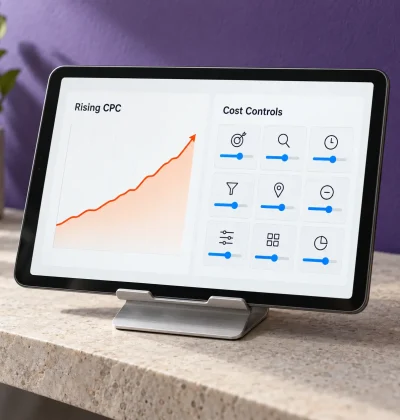
1. Placement bid adjustments. The largest unused lever available. Advertisers can adjust bids for top of search, product pages and rest of search, with rest of search adjustable “by up to 900%, same as the other two placements.” Pull back on top of search for products that convert fine in rest of search, and the blended cost falls without losing volume.
2. Negative exact gating. Amazon recommends “using phrase or exact match with negative keywords.” Negative exact blocks queries containing “the exact phrase or close variation.” Used deliberately, it stops you paying for a term in three places and seeing one blended number you cannot act on.
3. Search term pruning against spend, not ACoS. Sort by spend with zero orders rather than by ACoS. A term that spent 60 dollars and converted nothing is a decision. A term with a 70% ACoS on two orders is noise.
4. Ad group isolation by price band. Bids apply to every product in an ad group. Mixing a 19 dollar product with a 79 dollar one means one of them is always overbid. Splitting them is a cost reduction that requires no bid change at all.
5. Dynamic bidding discipline. With up and down selected, Amazon “will increase or decrease your bids by up to 100% for all placements” and advises being “prepared to potentially spend double the amount of the bid you input.” On products with thin margins, down only is often the correct setting and almost nobody revisits it.
6. Category benchmarking instead of guesswork. Amazon’s Benchmarks reporting provides “standardized performance comparisons against category peer brands,” including cost per click. This replaces the unsourced averages with your actual category. Use it before concluding your costs are a problem.
7. Budget architecture. Amazon’s own guidance sets the order: account-level budget, then portfolio-level, then campaign-level. Campaigns going dark at midday inflate effective cost by concentrating spend into the most competitive hours.
8. Shifting format where it fits. Sponsored Brands supports two pricing models, cost per click and cost per thousand viewable impressions. For upper-funnel objectives, paying for impressions rather than clicks changes the cost structure entirely.
9. Conversion rate. The lever that is not a bidding lever. At a 1.40 dollar cost per click and a 6% conversion rate, each sale costs about 23 dollars in ad spend. Lift conversion to 9% and the same traffic costs about 15.50 dollars per sale. Your CPC did not move. Your cost per acquisition fell by a third.
Nine levers, and only one of them is lowering a bid. If lowering bids is your whole response to rising costs, you have one tool and eight unopened ones. Focused placement modifiers alone usually move blended cost further in a week than a month of bid cuts.
Quick Verdict: what to do first
- Start with placement adjustments. Biggest lever, fastest signal, and most accounts have never touched them.
- Then split any ad group holding mixed price points. One bid cannot be correct for a 19 dollar and a 79 dollar product.
- Then prune by spend with zero orders, not by ACoS. ACoS on low order counts is noise and you will cut the wrong terms.
- Check Benchmarks before you panic. If your category rose more than you did, your account is performing and the market moved.
- Leave bid cuts last. They reduce cost by reducing volume, which is the one result you did not want.
What makes rising costs worse rather than better?
Four common responses, all of which feel decisive.
Cutting bids across the board. This lowers cost by lowering impressions. Position falls, organic rank follows a few weeks later, and the account looks more efficient while earning less. If you only measure ACoS you will not see it happen.
Pausing everything above a target ACoS. The terms with the worst ACoS often include the ones buying position during a launch or holding a competitive placement. A blanket rule cannot tell the difference between a bad term and an expensive one that is working.
Stacking automation on top of Amazon’s automation. Dynamic bidding already moves your bid by up to 100%. Adding a rules engine on top means two systems adjusting the same number on different schedules, which is how you end up with a cost per click nobody can explain.
Chasing a benchmark that does not exist. Setting a target cost per click from a blog average and optimising toward it is optimising toward a number Amazon has never published for a category that may behave nothing like yours.
There is a fifth response that is less common and more damaging: doing nothing while waiting for costs to come back down. Advertising costs on a maturing marketplace do not revert. Amazon’s advertising revenue has grown every year it has been reported separately, and that growth is advertisers bidding. An account that holds its structure constant through two years of that is losing ground slowly enough that no single month looks bad. The accounts that hold their cost per acquisition steady are the ones where someone is actively working to lower wasted ad spend every month, not the ones that found a good setup once.
How should you measure whether it is working?
Against your own baseline, on the metric that reflects your business rather than your ad account.
Record a 28-day baseline before changing anything: impressions, clicks, average cost per click, spend, orders, ACoS and total sales. Then change one thing at a time and re-measure at 28 days.
Watch total advertising cost of sales rather than ACoS alone. ACoS measures ad spend against ad-attributed revenue only, so it improves whenever you cut spend, including when you cut spend that was supporting organic sales. Total ACoS compares ad spend against total revenue, which catches that.
And watch cost per acquisition rather than cost per click. CPC is an input. Cost per acquisition is what you pay for a customer, and it is the number lever nine moves without touching a bid.
What this comes down to
The average Amazon cost per click everyone quotes does not exist. Amazon says so in its own documentation, and the demand-side pressure that does exist is visible in Amazon’s filed advertising revenue rather than in anyone’s benchmark table.
Your bid is a ceiling, not a price. The auction weighs factors Amazon does not publish, which means the levers worth pulling are the ones you fully control: placement, structure, negatives, budget order and the conversion rate of the page the click lands on.
If costs are climbing and your only response has been lowering bids, you have been managing the one lever that reduces cost by reducing sales. The other eight are sitting in the account already.
Frequently Asked Questions
What is the average Amazon cost per click?
Amazon does not publish one. Its own cost per click guide states “there won’t be a set number for the CPC of a brand’s ad,” because the final cost is set by an auction considering factors beyond your bid. Any average you see quoted is a third-party estimate. Use Amazon’s Benchmarks reporting for category peer comparison instead.
Why is my cost per click going up?
Demand is rising. Amazon’s advertising net sales reached 19.6 billion dollars in Q3 2026, up 11% year over year, which means more advertisers competing for the same impressions. Your own costs may also rise from placement mix, bid strategy or a conversion rate decline that makes the auction value your ad lower.
Does lowering my bid lower my cost per click?
Partly, and at a price. Your bid is a ceiling rather than the amount charged, so a 20% bid cut rarely produces a 20% cost cut. It does reliably reduce impressions and position, which lowers spend by lowering sales. Placement adjustments and ad group isolation usually move blended cost further without losing volume.
What is the biggest lever on Amazon advertising cost?
Placement bid adjustments. Amazon allows bid adjustment across three placements, top of search, product pages and rest of search, each by up to 900%. Most accounts run all three at default and accept a blended cost they never chose. It is the largest control most sellers have never used.
Does my listing affect my cost per click?
It affects what each sale costs, which matters more. Amazon states that detail page quality has a direct impact on ad performance. At a 1.40 dollar cost per click, lifting conversion from 6% to 9% cuts ad spend per sale from roughly 23 dollars to 15.50 without any bid change at all.
Resources and further reading
The following sources were used to inform and validate this article.
- Amazon Ads: Cost per click. Amazon’s statement that there is no set CPC number, that the final cost is auction-determined based on adjusted bid plus additional factors, and the definition of maximum cost per click.
- Amazon Q3 2026 results. Advertising services net sales of 19,637 million dollars versus 17,703 million a year earlier, an 11% year over year increase.
- Amazon Ads: Rest of search bid adjustment for Sponsored Products. Confirmation of three adjustable placements, each adjustable by up to 900%.
- Amazon Ads: Benchmarks reporting now generally available worldwide. Standardized performance comparisons against category peer brands, including cost per click.
- eMarketer: Advertising on Amazon is getting more expensive, but ROAS is holding steady. CommerceIQ data showing average cost per click up 11.6% year over year while return on ad spend stayed flat.